


springs


Member
1st Gear Member
Joined: Oct 2010
Posts: 82
From: Vancouver B.C.

OK, so you did the valves and springs, but did you make any changes to your shim stacks? Coz as I understand it that is almost as important as the valves. In fact, some tuners just mess with teh shim stacks usign the stock valves to get things working properly, although they only tend to do that on the higher end twin chamber/closed cartridge forks.
If you look at this thread on Thumper Talk there is a post on the shim stacks for the KTM bikes that might give you some ideas on what you can do with your bike to get the desired behaviours. (07 KTM 250 xcf-w fork shims - ThumperTalk)
Also, I see you have Flexx bars, which emans you can cheat a little with your damping. Depending on the rubbers you use with your bars you might be able to change your damping and oil weights so that the compression damping in the initial part of the fork stroke is not as plush (i.e. more compression damping) but use a lighter weight oil so the forks behave pretty similar to tehy do now - so you maintain decent front end traction on rougher ground (roots, square edges, etc). The lighter weight oil will plush up the mid stroke too and make the forks more prone to bottoming out in the last third of the stroke. To stop it bottoming out try getting your oil height right so that you get the full stroke used (like you want), but it's more air pressure locking that slows the last bit of travel rather than the spring being pully compressed. Then you rely on your Flexx Bars to absorb the last bit of "shock" when the forks have run through the full stroke so you don't break your wrists.
Hope that makes sense. It's just an idea based on theory, so I have no idea whether it will work or not. But you sound like you're not scared of playing with your forks, you know what you want, and trying things like this might get the desired results.
If you look at this thread on Thumper Talk there is a post on the shim stacks for the KTM bikes that might give you some ideas on what you can do with your bike to get the desired behaviours. (07 KTM 250 xcf-w fork shims - ThumperTalk)
Also, I see you have Flexx bars, which emans you can cheat a little with your damping. Depending on the rubbers you use with your bars you might be able to change your damping and oil weights so that the compression damping in the initial part of the fork stroke is not as plush (i.e. more compression damping) but use a lighter weight oil so the forks behave pretty similar to tehy do now - so you maintain decent front end traction on rougher ground (roots, square edges, etc). The lighter weight oil will plush up the mid stroke too and make the forks more prone to bottoming out in the last third of the stroke. To stop it bottoming out try getting your oil height right so that you get the full stroke used (like you want), but it's more air pressure locking that slows the last bit of travel rather than the spring being pully compressed. Then you rely on your Flexx Bars to absorb the last bit of "shock" when the forks have run through the full stroke so you don't break your wrists.
Hope that makes sense. It's just an idea based on theory, so I have no idea whether it will work or not. But you sound like you're not scared of playing with your forks, you know what you want, and trying things like this might get the desired results.
The shim stack is what I replaced, and believe most riders refer to as "valves". I guess the valves themselves are OE. I got the shims from Moto Pro.
The flexx bars are sweet. They are no remedy for poor dampening in the fork, although they take the edge off if the fork is spiking (not moving on a fast, hard hits) like the stock set up will do. The flexx bars are for my messed up hands, from too many mountain bike crashes over the years. I would recommend them to anyone with similar issues
If I cant get more travel in the next few rides I will play with the shim stacks and oil weight.
Member
1st Gear Member
Joined: Oct 2010
Posts: 82
From: Vancouver B.C.
If this is true someone should manufacture some after market valves.
Is your opinion from first hand experience.
One would think that shims would have a much greater impact on preformance than the valves.

Senior Member
Joined: Sep 2009
Posts: 5,050
From: Abilene, TX
1st Gear Member
Thanks for the response.
The shim stack is what I replaced, and believe most riders refer to as "valves". I guess the valves themselves are OE. I got the shims from Moto Pro.
The flexx bars are sweet. They are no remedy for poor dampening in the fork, although they take the edge off if the fork is spiking (not moving on a fast, hard hits) like the stock set up will do. The flexx bars are for my messed up hands, from too many mountain bike crashes over the years. I would recommend them to anyone with similar issues
If I cant get more travel in the next few rides I will play with the shim stacks and oil weight.
The shim stack is what I replaced, and believe most riders refer to as "valves". I guess the valves themselves are OE. I got the shims from Moto Pro.
The flexx bars are sweet. They are no remedy for poor dampening in the fork, although they take the edge off if the fork is spiking (not moving on a fast, hard hits) like the stock set up will do. The flexx bars are for my messed up hands, from too many mountain bike crashes over the years. I would recommend them to anyone with similar issues
If I cant get more travel in the next few rides I will play with the shim stacks and oil weight.

Senior Member
Joined: May 2010
Posts: 494
From: Sydney
1st Gear Member
1) Adjust just the shim stack (but keep the OEM valve)
2) Swap out the OEM valve with an aftermarket one (and keep your stock shim stack)
3) Replace your OEM valve with an aftermarket one AND adjust your shim stack to behave how you want it to.
Racetech make G2-r Gold Valves for our bikes.

With regards to your commend on shims having a greater impact than valves you must realise that each has an effect on the other, read this quote from an Aussie name Terry Hay that is a suspension guru (dbw - dirtbikeworld.net Members Forums - View Single Post - G2-R Gold Valves Behaviour
The ability to tune the port dimension is one the most significant innovations in suspension. The port dimension is relevent to the amount of force present at the shimstack. Forget suspension theory for a minute and take a step back to the basics. We are dealing with simple hydraulics made complex by so called "Black Art" mystics.
Hydraulic theory....Pressure over area = force.
Reduce area....reduce force.
Increase area....increase force
There is a ratio that exists between the area of the damper rod vs the total area of the ports. Much like a hydraulic car jack.
If the jack plunger is 1cm square and the ram is 20cm square then for each kilo of force at the plunger you will get 20 kilos of force at the ram. Hydraulic ratio 20:1
Increase the area of the ram to 40cm square and you will get 40 kilos of lifting force.
As you reduce the area of the ports you reduce the force acting on the shimstack. Lighter valve stacks will be utilized and greater discharge velocities will ensue. Less break away force required to overcome shimstack resistance for plusher initial feel and greater velocities will result in greater progression for added bottoming resistance.
Getting the ratio right is the secret. Too restrictive and harshness will follow. Not restrictive enough and effective control of the stroke will be a problem.
Hydraulic theory....Pressure over area = force.
Reduce area....reduce force.
Increase area....increase force
There is a ratio that exists between the area of the damper rod vs the total area of the ports. Much like a hydraulic car jack.
If the jack plunger is 1cm square and the ram is 20cm square then for each kilo of force at the plunger you will get 20 kilos of force at the ram. Hydraulic ratio 20:1
Increase the area of the ram to 40cm square and you will get 40 kilos of lifting force.
As you reduce the area of the ports you reduce the force acting on the shimstack. Lighter valve stacks will be utilized and greater discharge velocities will ensue. Less break away force required to overcome shimstack resistance for plusher initial feel and greater velocities will result in greater progression for added bottoming resistance.
Getting the ratio right is the secret. Too restrictive and harshness will follow. Not restrictive enough and effective control of the stroke will be a problem.
...calculating areas ... is a great start but lets not forget compressive velocities. Port dimension will have a greater effect as speed increases. The G2r allows the restrictor stack to be either solid or tapered. Meaning that the restrictor can be fixed or variable. Lets say you start with a 17mm (straight stack eg. 5 x 17 x .1) restrictor which provides excellent control for most of the velocities but gets a bit harsh on rocks, roots etc. The 17mm restrictor could be constructed in tapered form (17 15 13 12 11). This would allow a degree of flex in the restrictor to accomodate plushness at greater velocities with similar low speed effect.
Member
1st Gear Member
Joined: Oct 2010
Posts: 82
From: Vancouver B.C.
My apologies guys but I guess I did the valves as well as shims.
So...what is the part called that screws into the bottom of the fork with the holes in it for the oil to flow through, then through the valve and the shims?
I thought that was the valve body.
OK looked at the manual and they call the part that screws into the fork the cylinder valve assembly.
So...what is the part called that screws into the bottom of the fork with the holes in it for the oil to flow through, then through the valve and the shims?
I thought that was the valve body.
OK looked at the manual and they call the part that screws into the fork the cylinder valve assembly.
Last edited by Mcnutts; Jun 2, 2011 at 05:23 AM.

Senior Member
Joined: Feb 2009
Posts: 667
From: Hayward, CA
1st Gear Member
Yes, I started with the stock fork valves, then installed GoldValves, and then modified a set of KX forks to work in the KLX. I documented the conversion as shown here; HOW TO INSTALL KX-250 FORKS ON THE KLX-300
I have also reshimmed the shock.
The "valve" consists of the body and shims. Goldvalve for the forks uses 6-10 shims of varying diameter, compared to the 3 same diameter shims in the stock fork valve.
Here's a photo of the stock KLX300 fork valve:
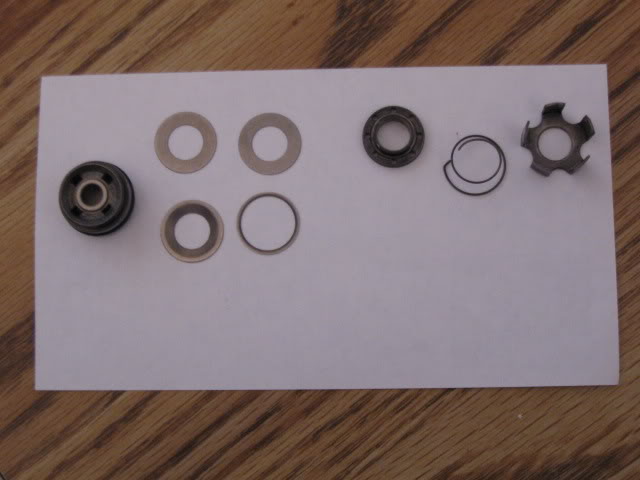
Ride on
Brewster
I have also reshimmed the shock.
One would think that shims would have a much greater impact on preformance than the valves.
Here's a photo of the stock KLX300 fork valve:
Ride on
Brewster

Senior Member
1st Gear Member
Joined: Sep 2010
Posts: 695
From: Western NY
All interesting. YES Mcnutts you did the valve and shim stack. Its the only way you can rebuild it. The setup is probably right.
The only way I can get the forks to bottom is trying to do a stoppie. Remember I drive an SF with 1.15 front springs, yes that is double + as stiff as yours ( ) . SO a good high speed brake application will tell you if its valving (which I doubt) or something inside the fork. Rear spring is 6.8 compared to the 5.8 on the S model. Rear links are also different.
I just measured my zip tie. 8 1/8" travel out of 9". This is over the past thousand or so miles. Funny thing, it was 7.5" not counting the sag (16mm). I have 1" less travel than the 09 S model. This measurement includes many attempted stoppies.
I have NOT heard the "clunk" I used to before the valve upgrade. This was only when trying to do a stoppie and the forks would bottom out.
I used the OE fork oil and springs when I did the moto pro upgrade. I did not remove it or measure. Its what was in there when the bike was new.
The screw in the valve is a bypass. The more you open it up, the more oil can flow through with out going through the shim stack (or compression valve). If you are 3 clicks from totally open, those last 3 will not do much. When I had mine apart I blew through the center hole and turned the screw. All the way in blocks all oil. All the way out lets only X amount of oil through. I have no clue what X is. This screw will effect both high speed and low speed compression. I got lucky and my front works well at the recommended 12 clicks from closed.
Another useless note. I have NOT successfully lifted the rear tire yet. Just a beginner and a little squeamish of locking up the front tire.
Brewster, your KLX 300 OE compression valve looks exactly like the one in my 09 KLX250SF
David
The only way I can get the forks to bottom is trying to do a stoppie. Remember I drive an SF with 1.15 front springs, yes that is double + as stiff as yours (
) . SO a good high speed brake application will tell you if its valving (which I doubt) or something inside the fork. Rear spring is 6.8 compared to the 5.8 on the S model. Rear links are also different.I just measured my zip tie. 8 1/8" travel out of 9". This is over the past thousand or so miles. Funny thing, it was 7.5" not counting the sag (16mm). I have 1" less travel than the 09 S model. This measurement includes many attempted stoppies.
I have NOT heard the "clunk" I used to before the valve upgrade. This was only when trying to do a stoppie and the forks would bottom out.
I used the OE fork oil and springs when I did the moto pro upgrade. I did not remove it or measure. Its what was in there when the bike was new.
The screw in the valve is a bypass. The more you open it up, the more oil can flow through with out going through the shim stack (or compression valve). If you are 3 clicks from totally open, those last 3 will not do much. When I had mine apart I blew through the center hole and turned the screw. All the way in blocks all oil. All the way out lets only X amount of oil through. I have no clue what X is. This screw will effect both high speed and low speed compression. I got lucky and my front works well at the recommended 12 clicks from closed.
Another useless note. I have NOT successfully lifted the rear tire yet. Just a beginner and a little squeamish of locking up the front tire.
Brewster, your KLX 300 OE compression valve looks exactly like the one in my 09 KLX250SF
David
Last edited by David R; Jun 2, 2011 at 09:26 PM.

Thread
Thread Starter
Forum
Replies
Last Post
