


Oops, dumb question on dynojet spring


Senior Member
1st Gear Member
Joined: Mar 2013
Posts: 866
From: SE Asia

Some additional thoughts on obtaining quicker throttle response:
If you were to add something like round Delrin rod to the top center of the carb cap; pointing down through the center of the spring, it would reduce the volume above the slide. Reduced volume should let the slide react faster as its upper cavity "empties out" quicker therefore letting atmospheric pressure push the underside up faster.
That pronged spring locater inside the carb cap is just held in by a rivet in the center. I'd already added Delrin rod to mine, but then opted for the 36mm and haven't really done any more work on the 34.
Maybe trimmed along it's sides slightly to allow free return spring movement
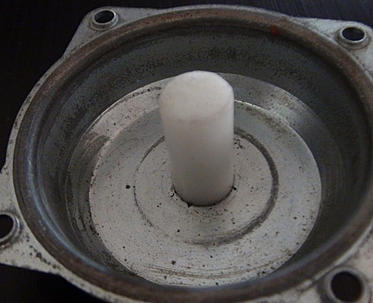
I did it to the 4 CV carbs on my GS1150 15 years ago and it did help low end power/throttle response enough that I had to go one step leaner with the pilot jets.


Senior Member
Joined: Aug 2009
Posts: 4,656
From: Delaware, Ohio
1st Gear Member
I know this is going to be like B'er Rabbit and the tar baby, but...
The air volume drawn out will be equal to the free space between the inside bottom of the slide when fully closed and the free space between the slide when fully open. The vacuum draws out that volume of air at the fixed flow rate allowed by the design, not emptying the entire chamber, making the reduction in volume inconsequential.
Filling up the excess space will not speed that process any more than sticking ice cubes in a drink will enable one to draw higher flow through the straw. And if one only drinks 1/2 the volume of drink they will not do so any quicker if 1/4 the volume is ice. One can only draw the volume allowed by the straw to the half way point where they plan to stop.
Then there is the fact that the vacuum chamber of the slide is not a sealed volume, there is an air bleed system. There is air drawn in to hold the slide at a point based on the strength of the vacuum and the resistance of the spring. If there wasn't an air bleed the slide would be sucked fully to the top and stuck at full throttle. The engine vacuum would be working as a positive displacement pump sucking all the air possible to be drawn out. It does not work that way, it depends on air flow. Again, it will only draw out the volume until the slide tops out.
At least that's what happens in fluid flow... it's all about flow, not volume. This is a case of fluid flow. Quicker flow and/or higher vacuum, not to mention a lower rate slide spring makes the slide rise faster.
Now, to quote B'er Rabbit, "Please, don't throw me in that briar patch".
The air volume drawn out will be equal to the free space between the inside bottom of the slide when fully closed and the free space between the slide when fully open. The vacuum draws out that volume of air at the fixed flow rate allowed by the design, not emptying the entire chamber, making the reduction in volume inconsequential.
Filling up the excess space will not speed that process any more than sticking ice cubes in a drink will enable one to draw higher flow through the straw. And if one only drinks 1/2 the volume of drink they will not do so any quicker if 1/4 the volume is ice. One can only draw the volume allowed by the straw to the half way point where they plan to stop.
Then there is the fact that the vacuum chamber of the slide is not a sealed volume, there is an air bleed system. There is air drawn in to hold the slide at a point based on the strength of the vacuum and the resistance of the spring. If there wasn't an air bleed the slide would be sucked fully to the top and stuck at full throttle. The engine vacuum would be working as a positive displacement pump sucking all the air possible to be drawn out. It does not work that way, it depends on air flow. Again, it will only draw out the volume until the slide tops out.
At least that's what happens in fluid flow... it's all about flow, not volume. This is a case of fluid flow. Quicker flow and/or higher vacuum, not to mention a lower rate slide spring makes the slide rise faster.
Now, to quote B'er Rabbit, "Please, don't throw me in that briar patch".
Last edited by klx678; Nov 29, 2014 at 12:10 PM.
Senior Member
1st Gear Member
Joined: Mar 2013
Posts: 866
From: SE Asia
I know this is going to be like B'er Rabbit and the tar baby, but...
The air volume drawn out will be equal to the free space between the inside bottom of the slide when fully closed and the free space between the slide when fully open. The vacuum draws out that volume of air at the fixed flow rate allowed by the design, not emptying the entire chamber, making the reduction in volume inconsequential.
Then there is the fact that the vacuum chamber of the slide is not a sealed volume, there is an air bleed system. There is air drawn in to hold the slide at a point based on the strength of the vacuum and the resistance of the spring. If there wasn't an air bleed the slide would be sucked fully to the top and stuck at full throttle. The engine vacuum would be working as a positive displacement pump sucking all the air possible to be drawn out. It does not work that way, it depends on air flow. Again, it will only draw out the volume until the slide tops out.
Now, to quote B'er Rabbit, "Please, don't throw me in that briar patch".
The air volume drawn out will be equal to the free space between the inside bottom of the slide when fully closed and the free space between the slide when fully open. The vacuum draws out that volume of air at the fixed flow rate allowed by the design, not emptying the entire chamber, making the reduction in volume inconsequential.
Then there is the fact that the vacuum chamber of the slide is not a sealed volume, there is an air bleed system. There is air drawn in to hold the slide at a point based on the strength of the vacuum and the resistance of the spring. If there wasn't an air bleed the slide would be sucked fully to the top and stuck at full throttle. The engine vacuum would be working as a positive displacement pump sucking all the air possible to be drawn out. It does not work that way, it depends on air flow. Again, it will only draw out the volume until the slide tops out.
Now, to quote B'er Rabbit, "Please, don't throw me in that briar patch".
If the rate of evacuation is fixed, then a reduction in volume would still increase throttle response. Looking at the idea from the other direction: if you connected a 1/2" ID diameter hose to the carb lid, and that was connected to a sealed 5 gallon container, I'd bet you would see throttle response is now much slower as the volume is now so much larger.
The slide wouldn't be stuck at the top at WOT because vacuum strength would diminish to almost nothing once the butterfly was closed, and the spring would force it back down. If the only thing changed was the volume then normal carb function wouldn't be impaired.
Spring rate, fixed rate, air bleed, engine vacuum etc all remaining the same-reducing volume would have to lead to a quicker throttle response. Atmospheric pressure is always waiting to fill the space evacuated of air.
Upper slide volume in cc div by fixed rate of evacuation (ccpm) = rate of slide rise. Ipso facto
No sense going back and forth over it and hijacking this thread. Keep in mind that I did this mod to the 4 carbs on my GS1150 and it would light the tire from a slow roll punch easier than before I did it. - Results once again overriding theory.
I told the guy who bought that bike about the mod and he said it made sense to him.

linky
Last edited by Richard Avatar; Nov 29, 2014 at 09:25 PM.
Senior Member
Joined: Aug 2009
Posts: 4,656
From: Delaware, Ohio
1st Gear Member
You are correct, I am incorrect. I will say fact did not override theory, theory is that formula you quoted to justify the results - correctly. Science virtually always wins.
I don't take things at face value at times, I need to understand and question. This one did that with me. When you said "suck the air out quicker" it just didn't ring true. If you had gotten a bit more specific and said it was drawing down the pressure quicker as it met resistance, that would have triggered more thought and understanding. The more I thought about it and reasoned out the facts today, the more I can see why it works and should have an effect, big or small it should have an effect.
As for someone believing something works because they are told it does... that's what sold the Tornado intake swirling device and magnetic fuel line devices. Neither of which actually work as claimed when put to the real test.
At first reading the concept did not make sense as the slide lifted allowing the flow with little resistance removing a set volume. Then thinking as the spring provides resistance, the volume would come into play, since, as you say, the draw would meet resistance and start drawing pressure down until it equalized with the spring at the given throttle opening. This, as you say, would be quicker with lower volume moving the slide faster. It is pneumatics versus hydraulics and I was thinking more hydraulics - not considering the characteristics of gasses under variable pressure, positive or negative.
I now understand what is occurring in the process. That is key to me.
This would be an interesting thing to be able to test out on a dyno to compare quickness of acceleration. See what gain is actually made under a set load. In other words, quantify it to gauge effectiveness - is it worth doing.
I may have to try this, just because... because it isn't costly and, done right, would have no negative effect... and I'm going to be taking things apart a bit this winter.
other than the gram or two addition to overall weight of the bike.
If all threads stayed on topic over half the content of value would be gone!
I don't take things at face value at times, I need to understand and question. This one did that with me. When you said "suck the air out quicker" it just didn't ring true. If you had gotten a bit more specific and said it was drawing down the pressure quicker as it met resistance, that would have triggered more thought and understanding. The more I thought about it and reasoned out the facts today, the more I can see why it works and should have an effect, big or small it should have an effect.
As for someone believing something works because they are told it does... that's what sold the Tornado intake swirling device and magnetic fuel line devices. Neither of which actually work as claimed when put to the real test.
At first reading the concept did not make sense as the slide lifted allowing the flow with little resistance removing a set volume. Then thinking as the spring provides resistance, the volume would come into play, since, as you say, the draw would meet resistance and start drawing pressure down until it equalized with the spring at the given throttle opening. This, as you say, would be quicker with lower volume moving the slide faster. It is pneumatics versus hydraulics and I was thinking more hydraulics - not considering the characteristics of gasses under variable pressure, positive or negative.
I now understand what is occurring in the process. That is key to me.
This would be an interesting thing to be able to test out on a dyno to compare quickness of acceleration. See what gain is actually made under a set load. In other words, quantify it to gauge effectiveness - is it worth doing.
I may have to try this, just because... because it isn't costly and, done right, would have no negative effect... and I'm going to be taking things apart a bit this winter.
other than the gram or two addition to overall weight of the bike.
If all threads stayed on topic over half the content of value would be gone!
Last edited by klx678; Nov 30, 2014 at 04:40 PM.
Senior Member
1st Gear Member
Joined: Mar 2013
Posts: 866
From: SE Asia
You are correct, I am incorrect. I will say fact did not override theory, theory is that formula you quoted to justify the results - correctly. Science virtually always wins.
I don't take things at face value at times, I need to understand and question. This one did that with me. When you said "suck the air out quicker" it just didn't ring true. If you had gotten a bit more specific and said it was drawing down the pressure quicker as it met resistance, that would have triggered more thought and understanding. The more I thought about it and reasoned out the facts today, the more I can see why it works and should have an effect, big or small it should have an effect.
As for someone believing something works because they are told it does... that's what sold the Tornado intake swirling device and magnetic fuel line devices. Neither of which actually work as claimed when put to the real test.
At first reading the concept did not make sense as the slide lifted allowing the flow with little resistance removing a set volume. Then thinking as the spring provides resistance, the volume would come into play, since, as you say, the draw would meet resistance and start drawing pressure down until it equalized with the spring at the given throttle opening. This, as you say, would be quicker with lower volume moving the slide faster. It is pneumatics versus hydraulics and I was thinking more hydraulics - not considering the characteristics of gasses under variable pressure, positive or negative.
I now understand what is occurring in the process. That is key to me.
This would be an interesting thing to be able to test out on a dyno to compare quickness of acceleration. See what gain is actually made under a set load. In other words, quantify it to gauge effectiveness - is it worth doing.
I may have to try this, just because... because it isn't costly and, done right, would have no negative effect... and I'm going to be taking things apart a bit this winter.
other than the gram or two addition to overall weight of the bike.
If all threads stayed on topic over half the content of value would be gone!
I don't take things at face value at times, I need to understand and question. This one did that with me. When you said "suck the air out quicker" it just didn't ring true. If you had gotten a bit more specific and said it was drawing down the pressure quicker as it met resistance, that would have triggered more thought and understanding. The more I thought about it and reasoned out the facts today, the more I can see why it works and should have an effect, big or small it should have an effect.
As for someone believing something works because they are told it does... that's what sold the Tornado intake swirling device and magnetic fuel line devices. Neither of which actually work as claimed when put to the real test.
At first reading the concept did not make sense as the slide lifted allowing the flow with little resistance removing a set volume. Then thinking as the spring provides resistance, the volume would come into play, since, as you say, the draw would meet resistance and start drawing pressure down until it equalized with the spring at the given throttle opening. This, as you say, would be quicker with lower volume moving the slide faster. It is pneumatics versus hydraulics and I was thinking more hydraulics - not considering the characteristics of gasses under variable pressure, positive or negative.
I now understand what is occurring in the process. That is key to me.
This would be an interesting thing to be able to test out on a dyno to compare quickness of acceleration. See what gain is actually made under a set load. In other words, quantify it to gauge effectiveness - is it worth doing.
I may have to try this, just because... because it isn't costly and, done right, would have no negative effect... and I'm going to be taking things apart a bit this winter.
other than the gram or two addition to overall weight of the bike.
If all threads stayed on topic over half the content of value would be gone!
The benefits are probably more pronounced on a 1150cc 4 cylinder than on a single cylinder.
The Delrin should be shaped/ground so as to create as little drag in the spring as possible while it's compressing yet still hoping to add as much Delrin to reduce volume.
What about lightening the wings of the slide?
Senior Member
Joined: Aug 2009
Posts: 4,656
From: Delaware, Ohio
1st Gear Member
Didn't really pay attention to them in the 250, but know what you mean, I have a spare slide for the 550 laying around. If thick enough some relief grinding on the back side with a Dremel could make sense. I'd think the spring would likely be the best way to quicken response. I'd also venture to say your chamber reduction would be a lot less risk to damaging a part and I'm not so sure there's a lot of weight to lose on that small amount of plastic.
My comment about dyno charts was if they showed any rate of the curve related to time. Kind of like what would be needed if nothing but flywheel weight was removed. No change in actual horsepower, but a change in rate of engine acceleration. But since I've not done any dyno stuff I have no clue if this is possible.
The place where this could be noticeable for my kind of use would be in response on a trail, maybe blipping to clear a rut or small log. Find a fairly technical section, ridden frequently enough to possibly feel the effect.
My comment about dyno charts was if they showed any rate of the curve related to time. Kind of like what would be needed if nothing but flywheel weight was removed. No change in actual horsepower, but a change in rate of engine acceleration. But since I've not done any dyno stuff I have no clue if this is possible.
The place where this could be noticeable for my kind of use would be in response on a trail, maybe blipping to clear a rut or small log. Find a fairly technical section, ridden frequently enough to possibly feel the effect.
Senior Member
1st Gear Member
Joined: Mar 2013
Posts: 866
From: SE Asia
A lot of the slide wing area is never exposed to the venturi and could probably be drilled etc.
If I was playing around with my 34mm I'd probably try adding a vacuum port ahead of the butterfly, then run a hose to the carb cap to see if throttle response could be improved.
You'd have to seal the hole in the base of the slide to make it work.
If I was playing around with my 34mm I'd probably try adding a vacuum port ahead of the butterfly, then run a hose to the carb cap to see if throttle response could be improved.
You'd have to seal the hole in the base of the slide to make it work.

Senior Member
Joined: Oct 2010
Posts: 4,507
From: SW Idaho
1st Gear Member
I've heard some of the KLR guys complain that after drilling the stock slider (perhaps a little larger than recommended) and/or making spring weight changes, the slider would flutter up and down while running at highway speeds, apparently due to wind pressure changes.
Senior Member
1st Gear Member
Joined: Mar 2013
Posts: 866
From: SE Asia
Too bad it'd be so difficult to make an add-on accelerator pump for the CVK. You could use the emissions port on the top carb's spigot.
Guess someone needs to get hold of a CVK 34 with AP we keep reading about and see how that perks up the CV equipped KLX.
But for like $100 or so more, once you count in all the adapting and time invested that's necessary to try other carbs, the 36 Mikuni is still the #1 no brainer best choice.
Guess someone needs to get hold of a CVK 34 with AP we keep reading about and see how that perks up the CV equipped KLX.
But for like $100 or so more, once you count in all the adapting and time invested that's necessary to try other carbs, the 36 Mikuni is still the #1 no brainer best choice.

