


More of a crankcase "venting" question than a "mod"?


Thread Starter
|
Junior Member
Joined: Dec 2023
Posts: 28
From: Gulf Shores
1st Gear Member
 More of a crankcase "venting" question than a "mod"?
It looked like someone had 'tinkered' with the CC vent vac module thing/09 KLX250 (just behind the radiator with large hose that runs to top of airbox and small vac hose to carb). So, I removed the vacuum module, capped off the vacuum line at the carb, and just ran that cc vent hose straight to the top of the air box. Make sense?
So in short, I have the bottom cc hose going from engine straight to bottom/airbox, and the top hose going from top/front of motor straight of top of airbox. Nothing in between, both hoses just straight to appropriate airbox inlets.
Does anyone see an issue with this? So, (as far as I know) vacuum from the carb/acceleration will draw cc air in all the time keeping negative air pressure in the cc with no ill effects (other than that air going into carb which doesnt bother me).
Also, what is the path of the cc vent/air flow?
Thoughts? Thanks in advance
So in short, I have the bottom cc hose going from engine straight to bottom/airbox, and the top hose going from top/front of motor straight of top of airbox. Nothing in between, both hoses just straight to appropriate airbox inlets.
Does anyone see an issue with this? So, (as far as I know) vacuum from the carb/acceleration will draw cc air in all the time keeping negative air pressure in the cc with no ill effects (other than that air going into carb which doesnt bother me).
Also, what is the path of the cc vent/air flow?
Thoughts? Thanks in advance
Last edited by RECON250s; Jan 7, 2024 at 12:50 AM.

Senior Member
Joined: Aug 2009
Posts: 4,652
From: Delaware, Ohio
1st Gear Member
If you're leaving the stuff there you may as well hook up the intake vacuum and let it work. I would venture to say the valve now isn't working with no air being drawn in. Removing it only saves the weight of the parts, nothing else. There is no effect on performance by disconnecting or removing the PAIR valve. It just means a bit more pollution when it doesn't work.
I only took the system off my bike when I changed carburetors to one without the vacuum fitting. Then I blocked off the head opening. If the carb had the fitting I'd have left it on. It was a bit of a pain in the butt to plug the air box, finding a cap for the hole, and to put a block plate on the head.
I only took the system off my bike when I changed carburetors to one without the vacuum fitting. Then I blocked off the head opening. If the carb had the fitting I'd have left it on. It was a bit of a pain in the butt to plug the air box, finding a cap for the hole, and to put a block plate on the head.
Thread Starter
|
Junior Member
Joined: Dec 2023
Posts: 28
From: Gulf Shores
1st Gear Member
If you're leaving the stuff there you may as well hook up the intake vacuum and let it work. I would venture to say the valve now isn't working with no air being drawn in. Removing it only saves the weight of the parts, nothing else. There is no effect on performance by disconnecting or removing the PAIR valve. It just means a bit more pollution when it doesn't work.
I only took the system off my bike when I changed carburetors to one without the vacuum fitting. Then I blocked off the head opening. If the carb had the fitting I'd have left it on. It was a bit of a pain in the butt to plug the air box, finding a cap for the hole, and to put a block plate on the head.
I only took the system off my bike when I changed carburetors to one without the vacuum fitting. Then I blocked off the head opening. If the carb had the fitting I'd have left it on. It was a bit of a pain in the butt to plug the air box, finding a cap for the hole, and to put a block plate on the head.
That's the way it works when the Rottweiler air intake is installed on the 690... the cc vent hoses both come to a collection/catch can type box, the the breather line either go to clean side of air intake or runs up higher by itself with a K&N type mini-filter.
Thanks for the input
Senior Member
Joined: Aug 2009
Posts: 4,652
From: Delaware, Ohio
1st Gear Member
The crank case breather hose simply goes from the crank case to the air box. The PAIR has nothing to do with the crank case ventilation and is not connected to the crank case unless someone really screwed with those hoses. The PAIR hoses and valve are only a source for air to suck into the exhaust to burn unburned fuel mix.
The thing that makes the most sense is to block off all three ports related to the PAIR system. Cap the opening on the air box where the line comes out to the valve. Cap the opening on the reed block on the head. Block the vacuum port. That or put the system back together right. The tube from the top port in the air box goes to the side port on the PAIR valve, then a tube on the bottom of the valve goes to the reed valve in the head. Then there is the vacuum hose.
See the set up below.
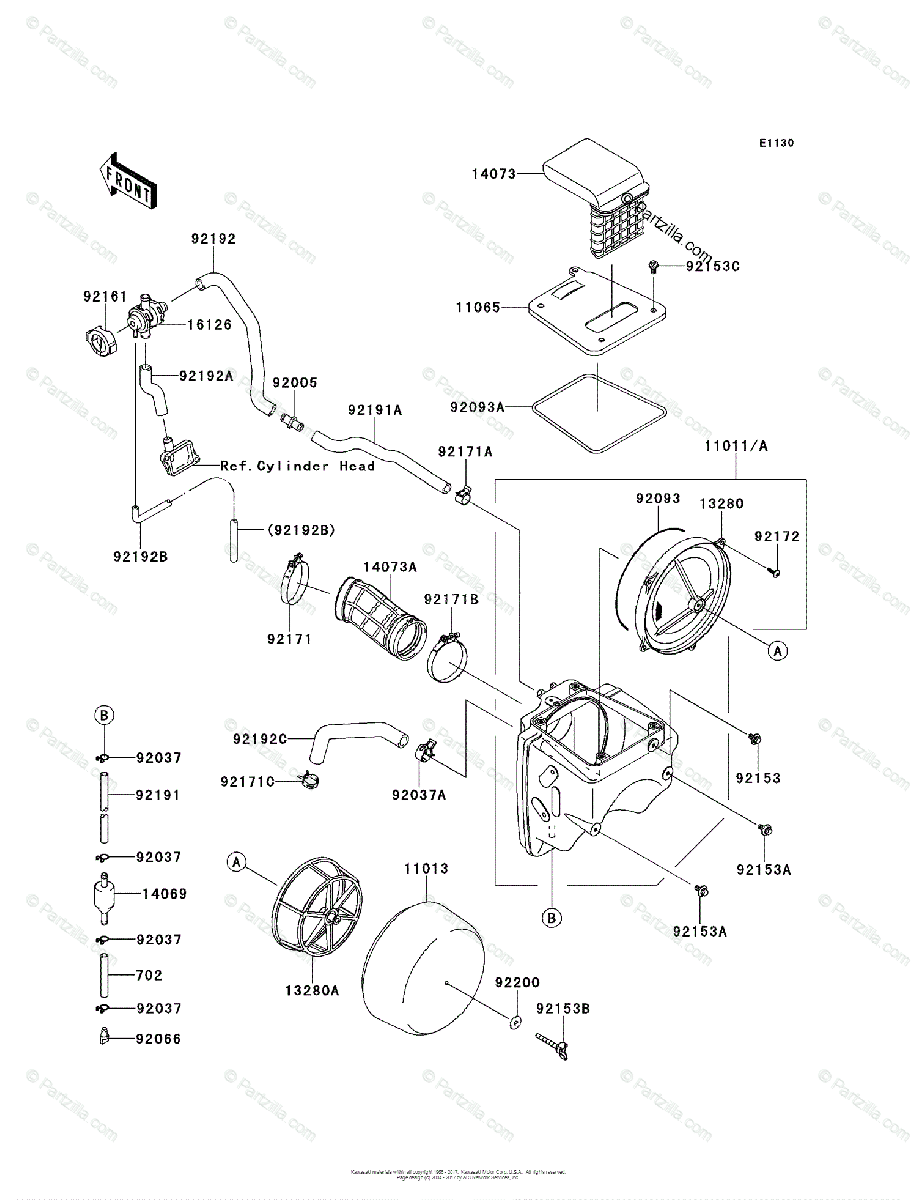
The thing that makes the most sense is to block off all three ports related to the PAIR system. Cap the opening on the air box where the line comes out to the valve. Cap the opening on the reed block on the head. Block the vacuum port. That or put the system back together right. The tube from the top port in the air box goes to the side port on the PAIR valve, then a tube on the bottom of the valve goes to the reed valve in the head. Then there is the vacuum hose.
See the set up below.
Thread Starter
|
Junior Member
Joined: Dec 2023
Posts: 28
From: Gulf Shores
1st Gear Member
The crank case breather hose simply goes from the crank case to the air box. The PAIR has nothing to do with the crank case ventilation and is not connected to the crank case unless someone really screwed with those hoses. The PAIR hoses and valve are only a source for air to suck into the exhaust to burn unburned fuel mix.
The thing that makes the most sense is to block off all three ports related to the PAIR system. Cap the opening on the air box where the line comes out to the valve. Cap the opening on the reed block on the head. Block the vacuum port. That or put the system back together right. The tube from the top port in the air box goes to the side port on the PAIR valve, then a tube on the bottom of the valve goes to the reed valve in the head. Then there is the vacuum hose.
See the set up below.
The thing that makes the most sense is to block off all three ports related to the PAIR system. Cap the opening on the air box where the line comes out to the valve. Cap the opening on the reed block on the head. Block the vacuum port. That or put the system back together right. The tube from the top port in the air box goes to the side port on the PAIR valve, then a tube on the bottom of the valve goes to the reed valve in the head. Then there is the vacuum hose.
See the set up below.
Last edited by RECON250s; Jan 9, 2024 at 02:55 PM.
Senior Member
Joined: Aug 2009
Posts: 4,652
From: Delaware, Ohio
1st Gear Member
Glad I could help. It was getting me a bit confused along the way. I will also say I have had stuff like that screw me around as well. Not like I'm some expert by any stretch.
I just noticed the Yamaha... had to look that one up. Never have ridden a personal watercraft. We carried Kaw back in the 80s for a bit. Didn't sell well where we were, in the middle of town, no lake too close and those that were around had horsepower limits that kept them off most lakes. I wish I'd had the opportunity to try one out. Like motorcycling on water I'd think.
I just noticed the Yamaha... had to look that one up. Never have ridden a personal watercraft. We carried Kaw back in the 80s for a bit. Didn't sell well where we were, in the middle of town, no lake too close and those that were around had horsepower limits that kept them off most lakes. I wish I'd had the opportunity to try one out. Like motorcycling on water I'd think.
Thread Starter
|
Junior Member
Joined: Dec 2023
Posts: 28
From: Gulf Shores
1st Gear Member
Glad I could help. It was getting me a bit confused along the way. I will also say I have had stuff like that screw me around as well. Not like I'm some expert by any stretch.
I just noticed the Yamaha... had to look that one up. Never have ridden a personal watercraft. We carried Kaw back in the 80s for a bit. Didn't sell well where we were, in the middle of town, no lake too close and those that were around had horsepower limits that kept them off most lakes. I wish I'd had the opportunity to try one out. Like motorcycling on water I'd think.
I just noticed the Yamaha... had to look that one up. Never have ridden a personal watercraft. We carried Kaw back in the 80s for a bit. Didn't sell well where we were, in the middle of town, no lake too close and those that were around had horsepower limits that kept them off most lakes. I wish I'd had the opportunity to try one out. Like motorcycling on water I'd think.
I'll post a pic of my stock muffler mod soon (simple but works). Next mission is to take the horrid rattle out of the aluminum skid plate!
On the PWCs... I was slow coming around to those about 5 hears ago (had a few), even having grown up on Pensacola Beach/Gulf Shores. Wife and I have had everything from skiffs, to larger Grady White walk-around cuddys, Yamaha Jet Boats, and now back to the Waverunner. Mid-55s, empty nesters... and turns out I married an 'explorer'. Correct, Waverunner is like a bike on the water. We took it up to Muscle Shoals to explore the TN River, and we explore a lot don here on the delta/gulf. We love it... and don't have to entertain on it, LOL!
So I'm just getting into the dual sport riding after 25 years on the road... don't even have a road bike anymore. Reach out anytime you happen to be in my area and you can take the PWC and go have a blast... I'll leave it in the driveway with the ignition code.
Thanks for the help...


Thread
Thread Starter
Forum
Replies
Last Post